Do You Believe the Flat Earth Myth
(and not even know it)?

The Flammarion Woodcut
Everyone knows the story of how Church officials strongly opposed Columbus’ voyage on the grounds that he would fall off the edge of the Earth.  If you paid attention in history class, then you would remember that Columbus’ success in reaching America is thought to have proved the Church wrong about the Earth being flat by finally providing irrefutable evidence that the Earth is a sphere.  Do you remember when you first learned this in school?

Some excerpts from grade school history textbooks which taught this:
“[Columbus] felt he would eventually reach the Indies in the East. Many Europeans still believed that the world was flat. Columbus, they thought, would fall off the earth.” America Past and Present (Scott Foresman, 1983), 98.
“The European sailor of a thousand years ago also had many other strange beliefs.  He turned to these beliefs because he had no other way to explain the dangers of the unknown sea.  He believed . . . that a ship could sail out to sea just so far before it fell off the edge of the sea. . . . The people of Europe a thousand years ago knew little about the world.” We the People (Heath, 1982), 28-29.
And this excerpt, from a middle school earth science textbook:
“For thousands of years, most people thought that the earth was flat. But as early as 300 B.C., the ancient Greeks theorized that the earth was round. Yet they still drew maps of a flat earth.
As people explored more of the world, they were able to map large areas of it. In 150 A.D., the famous Greek astronomer Ptolemy made maps that included Europe, Africa, and most of Asia. Even more important, these maps showed the earth as round!
For hundreds of years after Ptolemy's work, mapping was neglected. Much knowledge of the world, as well as the idea of a round earth, was forgotten. In the fourteenth century, interest in Ptolemy's work was renewed. Once again, people believed that the earth might be round. Columbus's voyage to the New World was final proof that it was indeed round.” Prentice Hall Earth Science (1991), 213.
The problem with all of these accounts is that they are utter nonsense!  States historian of science Jeffrey Burton Russell, “It must first be reiterated that with extraordinary few exceptions no educated person in the history of Western Civilization from the third century B.C. onward believed that the earth was flat” (“The Myth of the Flat Earth by Jeffrey Burton Russell).

The Flat Earth Myth
The Flat Earth Myth is not the belief that the Earth is flat (see The Flat Earth Society for those who do hold this belief).  Rather, the Flat Earth Myth is the notion that people in the past, particularly Medieval Christians, used to believe that the Earth was flat.  This belief is still widely accepted as historical fact (how many of you thought it was true before you read this?), and it has been infused into the caricature of Christians that is circulated today.

Ironically, America Past and Present was my history textbook in 5th grade.  And though this myth has been removed from most textbooks as a result of the work by historians of science, the fact is that many people continue to hold this belief, including many of the teachers currently teaching today.

You may have seen the image that appears at the top of this post.  It is called the Flammarion Woodcut, and it is often shown as an illustration of Middle Age belief in a flat Earth, when in fact the origin of the woodcut appears to be from the 19th century, and was not intended to convey the idea of a flat Earth view.

So how did this myth become so prevalent today?  Again, the popularization of this myth goes back to the 19th century, with historians like Andrew Dickson White (he who so loudly proclaimed the conflict thesis between Christianity and science) presenting the story of Columbus fighting with Church officials for support for his voyage:
The warfare of Columbus the world knows well: how the Bishop of Ceuta worsted him in Portugal; how sundry wise men of Spain confronted him with the usual quotations from the Psalms, from St. Paul, and from St. Augustine; how, even after he was triumphant, and after his voyage had greatly strengthened the theory of the earth's sphericity, with which the theory of the antipodes was so closely connected, the Church by its highest authority solemnly stumbled and persisted in going astray.” (A History of the Warfare of Science with Theology in Christendom, Volume 1, Chapter II.3, Geography: Theological hindrance of Columbus)
The idea that White seems to be trying to convey is that even after Columbus provided “proof” of the Earth’s sphericity, the church continued to persist in its mistaken belief in a flat Earth.  Irving - The Legend of Sleepy HollowIrving - Rip Van WinkleHowever, modern historians of science have conclusively demonstrated that White and his contemporaries were wrong to associate the Middle Age Church with belief in the flat Earth.  In actuality, the earliest mention that medieval people believed that the Earth was flat is found in the book, The Life and Voyages of Christopher Columbus, written by American writer Washington Irving, noted for other such historically accurate accounts as Rip Van Winkle and The Legend of Sleepy Hollow.

Consider Irving's description of the Council of Salamanca, during which Columbus tried to present the case for making his voyage before the learned men of his day, including various dignitaries of the church:
To his simplest proposition, the spherical form of the earth, were opposed figurative texts of Scripture.  They observed that in the Psalms the heavens are said to be extended like a hide, that is, according to commentators, the Irving - Life and Voyages of Columbuscurtain or covering of a tent, which among ancient pastoral nations, was formed of the hides of animals; and that St. Paul, in his Epistle to the Hebrews, compares the heavens to a tabernacle or tent, extended over the earth, which they thence inferred must be flat.” (The Life and Voyages of Christopher Columbus, 69).
Scans of the relevant pages can be found here.

Columbus’ Error
Columbus did indeed face resistance while searching for sponsors for his voyage, but the issue of contention was not whether the earth was flat or round, but over the size of the earth. Those who opposed Columbus believed that the circumference of the earth was too great for ships to sail around to the other side. There was no talk about “falling off the edge of the world.” Columbus had calculated that the distance for his trip from the Canary Islands to Japan would be about 4,450 km, which is one-fifth the actual distance of 22,000 km. If not for the placement of the Americas in between, Columbus and his crew would have surely perished, as his critics predicted. Columbus’ voyage—and later explorations by others—did not change the perception of the shape of the earth, but merely added new land masses to the Middle Age maps of the world.

Rather than being a bold triumph of science over superstition, Columbus’ voyage is proof that sometimes even dumb blind luck can make you famous.

Early Christian Thinkers who Wrote about the Spherical Earth
In fact, many early Christian thinkers wrote about the spherical Earth.

Thomas Aquinas (1225-1274) in his great systematic work Summa Theologica:
“Both an astronomer and a physical scientist may demonstrate the same conclusion, for instance that the earth is spherical; the first, however, works in a mathematical medium prescinding from material qualities, while for the second his medium is the observation of material bodies through the senses.” (Thomas Aquinas, Summa Theologica, vol. 1, trans. by Thomas Gilby (New York: McGraw-Hill Book Company, 1964), q.1, a.1.)
The French Roman Catholic bishop Nicole Oresme (1323-1382) proposed several playful paradoxes dealing with a round and rotating earth, including one that established the principle behind changing time zones and the international date line for east-west travels. (Nicole Oresme, Lu Livre du Ciel et du Monde (1370), Bk. II, ch. 31, pp. 573-581.)

Oresme’s teacher, Jean Buridan, discussed the rotation of the earth.

All three of these Middle Age thinkers wrote as if the round earth was common knowledge, not something that still needed to be established.

Observations Affirming a Spherical Earth
These thinkers also presented observational evidences for the sphericity of the Earth: 

1. The Shadow of the Earth during Lunar Eclipses
Lunar EclipseThomas Aquinas: “In [lunar] eclipses the outline [of the earth] is always curved: and, since it is the interposition of the earth that makes the eclipse, the form of this line will be caused by the form of the earth's surface, which is therefore spherical.” (Thomas Aquinas, Exposition of Aristotle's Treatise On the Heavens, 2 vols, trans. by Larcher, R. F., and Pierre H. Conway (Columbus, OH: College of St. Mary of the Springs, 1964), Book II, lect. 28. 400-402.)

2. Observation of the Stars in the Sky Johannes de Sacrobosco (1195-1256), an English monk, wrote an astronomical textbook that was used in universities for many centuries.
That the earth, too, is round is shown thus. The signs and stars do not rise and set the same for all men everywhere but rise and set sooner for those in the east than for those in the west; and of this there is no other cause than the bulge of the earth. Moreover, celestial phenomena evidence that they rise sooner for Orientals than for westerners. For one and the same eclipse of the moon which appears to us in the first hour of the night appears to Orientals about the third hour of the night, which proves that they had night and sunset before we did, of which setting the bulge of the earth is the cause. (Johannes de Sacrobosco, The Sphere, trans. by Lynn Thorndike, 1949, 10 Dec. 2004).
3. Observations of a ship’s mast
clip_image002[1]Sacrobosco also described how the dropping of a ship’s mast below the horizon as it sailed away was another proof of the spherical shape of the earth.  This is an observation that all sailors would be familiar with, thus of all people sailors would be the least likely to be concerned about falling off the edge of a flat Earth if they sailed too far.

These examples show that a spherical earth was already an accepted fact in the early 13th century. So where then did Andrew Dickson White get this notion that sailors were terrified of sailing over the edge of the ocean?
Many a bold navigator, who was quite ready to brave pirates and tempests, trembled at the thought of tumbling with his ship into one of the openings into hell which a widespread belief placed in the Atlantic at some unknown distance from Europe. This terror among sailors was one of the main obstacles in the great voyage of Columbus. (A History of the Warfare of Science with Theology in Christendom, Volume 1, Chapter II.1, Geography: The Form of the Earth)
Earlier Church Writings about a Spherical Earth
Even in the early Middle Ages, the Venerable Bede (673-735), a monk recognized as both a great historian and natural scientist, was already making clear statements about the earth as a sphere:
The cause of the inequality of the length of days is that the earth is round, and it is not in vain that in both the bible and pagan literature it is called the “orb of lands.” For truly it is an orb placed in the center of the universe; in its width it is like a circle, and not circular like a shield but rather like a ball, and it extends from its center with perfect roundness on all sides. (Bede, Bedae opera de temporibus, ed. C. W. Jones (Cambridge, Mass., 1943), chap. 32, quoted in Russell, 87)
He specifically points out that the earth is not a flat disk like a shield but an actual ball or globe. Bede’s writings show that by this point, the Church saw no Scriptural conflict with a spherical earth.

The Controversy Over Antipodes
But discussions about the round Earth appeared even earlier in Church history. A controversy that arose within the church involving the shape of the earth was the issue of antipodes, the idea of people living on the other side of the earth with their feet facing in the opposite direction. The debate over antipodes has wrongly been viewed as an example of the Church rejecting a spherical earth, as the rejection of antipodes is often confounded with the rejection of a round Earth view.
But consider this explanation from St. Augustine, writing in the 4th century in his City of God:
But as to the fable that there are Antipodes, that is to say, men on the opposite side of the earth, where the sun rises when it sets to us, men who walk with their feet opposite ours, that is on no ground credible. And, indeed, it is not affirmed that this has been learned by historical knowledge, but by scientific conjecture, on the ground that the earth is suspended within the concavity of the sky, and that it has as much room on the one side of it as on the other: hence they say that the part which is beneath must also be inhabited. But they do not remark that, although it be supposed or scientifically demonstrated that the world is of a round and spherical form, yet it does not follow that the other side of the earth is bare of water; nor even, though it be bare, does it immediately follow that it is peopled. For Scripture, which proves the truth of its historical statements by the accomplishment of its prophecies, gives no false information; and it is too absurd to say, that some men might have taken ship and traversed the whole wide ocean, and crossed from this side of the world to the other, and that thus even the inhabitants of that distant region are descended from that one first man. (Saint Augustine, The City of God, trans. by Marcus Dods (New York: Modern Library, 1993), Book XVI, chap. 9)
It can be clearly seen in this passage that Augustine does not refute the “scientific conjecture” that the earth is round, that “it has as much room on the one side of it as on the other.” What he rejects is the possibility that there could be inhabitants on this other side, men who were not descended from Adam. But from Augustine, we can see that even at such an early time in church history, a round earth was not considered to be an unacceptable view.

Earth Profile Busting the Flat Earth Myth
This brief survey of key Christian thinkers during the Middle Ages shows that the Church was not opposed to the concept of a spherical earth, and that the conflict surrounding a round earth were not about the shape of the earth but over the belief in antipodes, men who were not descended from the line of Adam. This does not mean that every single person who lived during the Middle Ages knew that the Earth was round.  Many of the common folk who were not educated about the issue probably lived their lives not knowing whether the Earth was round or flat, in the same way that many people today mistakenly believe that astronauts and objects in space float because there is no gravity in space. 

The key point is that, with only a handful of exceptions, no educated person during the Middle Ages believed in the concept of the flat earth. 

The two most oft cited exceptions are Lactantius (c. 245–325) and the early 6th century Greek geographer Cosmas Indicopleustes.  An essay by Thomas E. Woods’—author of How the Catholic Church Built Western Civilization—gives a brief explanation for why these two were not influential.

Russell offers this explanation for why the Flat Earth Myth has been served up as truth since the 19th century:
The reason for promoting both the specific lie about the sphericity of the earth and the general lie that religion and science are in natural and eternal conflict in Western society, is to defend Darwinism. The answer is really only slightly more complicated than that bald statement. The flat-earth lie was ammunition against the creationists. The argument was simple and powerful, if not elegant: "Look how stupid these Christians are. They are always getting in the way of science and progress. These people who deny evolution today are exactly the same sort of people as those idiots who for at least a thousand years denied that the earth was round. How stupid can you get?"

But that is not the truth.
(“The Myth of the Flat Earth” by Jeffrey Burton Russell)
Any critic of the Christian faith who accuses Christians of being ignorant and opposed to scientific advances would do well to examine the actual writings of these early Christians before continuing to propagate “The Flat Earth Myth.”
“Our determination to believe the Flat Error arises out of contempt for the past and our need to believe in the superiority of the present.” Russell, Inventing the Flat Earth

Inventing the Flat Earth (Russell)For additional reading, consider the following:

See the full text of Russell’s essay “The Flat Earth Myth” or his book, Inventing the Flat Earth: Columbus and Modern Historians

University of Oklahoma History of Science Exhibit on the Shape of the Earth

Article by historian of science James Hannam on The Myth of the Flat Earth

Gladio Mentis - The Sword of the Mind considers the Scriptural passages that are often mistakenly cited as "proof" that the Bible teaches a flat Earth in Round and Round We Go

Also, see this post from Hannam’s blog Quodlibeta on “The Deep Sleep of Adam” for some another example from the medical field of how Andrew Dickson White and others have misportrayed history when it comes to Christians and science.

The Star of Bethlehem

Merry Christmas! A bit of astronomy for today. I would like to introduce you to Frederick Larson and his website and DVD The Star of Bethlehem.

The Star of Bethlehem

This is something that I show my classes each year. It is a presentation defending the claim that the star of Bethlehem was a real astronomical event. Frederick Larson, a lawyer by day, goes through the Christmas story in the book of Matthew and builds a case showing how the planet Jupiter could have meet 9 specific criteria for the Star of Bethlehem.

Even though there are a few points where I think Larson may be trying to stretch the significance a bit too much, overall I feel that this is a very reasonable and well-researched presentation. I preface the showing of this video to my students by telling them that this may not be the actual star as recorded in Scripture, but this serves as an excellent example of how science can help booster our understanding of the credibility of the biblical writers. By tying real astronomical events to descriptions of the star given in Scripture, Larson provides a reasonable explanation for what may have brought the Magi to the town of Bethlehem to see the baby Jesus. He also uses astronomical data to try to pin down the actual date of Jesus' crucifixion, which I felt was actually the strongest part of Larson's presentation. Some interesting discussions on astronomy and the Bible and the meaning of miracles always follows the showing of this video, especially if you use some astronomy software to recreate the scenarios presented by Larson.

I recommend the use of the free, open source planetarium software Stellarium if you would like to see the try this out yourself! I used version 9.1, which had a scripting function. The new version 10 has a nicer interface and it is easier to set time and location, but the script function hasn't been implemented yet. Here are the location and time settings for the 3 main "scenes" for the Star of Bethlehem:

1. Triple conjunction between Jupiter and Regulus
Starting Date and Time: Sept. 1, 2 BC, UTC 00:30:00
Location: Lat 32.34, Lon 44.22 (ancient Babylon)
Constellations On
Track Jupiter

2. Conjunction between Jupiter and Venus
Starting Date and Time: June 13, 1 BC, UTC 17:30:00
Location: Same as before, in Babylon

3. Jupiter in retrograde motion over Bethlehem
Starting Date and Time: Dec. 17, 1 BC, UTC 06:00:00
Location: Lat 31.71, Lon -35.10 (Jerusalem)
Look South toward the town of Bethlehem

The "Conflict Thesis" between Science and Christianity

As described in the previous post, Christians are often caricaturized as holding on tightly to anti-scientific views, such as a flat Earth and geocentrism, in spite of strong scientific evidence to the contrary.  In later posts in this series, I hope to provide primary source documentation to help us understand the issue of belief in the flat Earth and the debate between geocentrism vs. heliocentrism, especially as it pertained to the trial of Galileo. But first it is important to understand a bit of the history behind this idea that Christianity and Science have always been in opposition, sometimes referred to as the "Conflict Thesis."

The Origin of the Conflict Thesis
The popularization of the “Conflict Thesis” can be traced back to two influential textbooks (both of which are still being printed and sold today):

John Draper, History of the Conflict between Religion and Science (1875)
Andrew White, A History of the Warfare of Science with Theology in Christendom (1896)

Consider these statements by Draper and White:
“Roman Christianity and Science are recognized by their respective adherents as being absolutely incompatible; they cannot exist together; one must yield to the other; mankind must make it’s choice – it cannot have both.” (Draper, History… 363)

“In all modern history, interference with science in the supposed interest of religion, no matter how conscientious such interference may have been, has resulted in the direst evils both to religion and to science.” (White)

Even two hundred years later, their influence continues.  As I mentioned, both of these books are still being sold today, and one particular review of White's book on Amazon caught my attention. It's titled: Great history of the torture of scientists by theologians:

“Originally written in 1886, this is a comprehensive account of clashes between theological and scientific claims about how nature works. White systematically chronicles the persecution all the major areas of scientific inquiry had to go through from theologans before they were accepted : geology, mechanics, medicine, meteorology, biology, etc....  [B]ased on historical evidence, religious thinking *in science* [sic] only stunts the creativity and logical thought processes of scientists. In my experience in neuroscience, I have seen this many times.” (E. Thomson)
You may also find the review by Keith Wells, one of my colleagues from Biola's MASR program, and the subsequent comments, interesting.

A Scientific Revolution Against Religion?
E. Thomson's review gives the conventional wisdom of today, that scientists had to struggle to free science from the shackles of religious thinking.  The common belief is that the Scientific Revolution was a triumph of reason over religion, as these early scientists formulated and applied the scientific method to provide conclusive evidence which finally undermined the authority of the Church.  But this description of the agenda of the Scientific Revolution would be emphatically denied by the very scientists upon whose work much of modern science is based. Rather than being a revolt against religion, the basic principles of the Scientific Revolution are in fact rooted in the theological beliefs of these early scientists.

A Belief in a Rational Universe
A critical component to the rise of modern science is a belief in the rationality of the universe.  The universe follows laws that are defined, consistent, and uniform.  It was the Christian belief in an infinite, eternal, and personal God who made this universe which gave the fathers of modern science a basis for the rationality of the universe. 

To men like Galileo, Kepler, Newton, and Bacon, the creation was orderly and uniform because it was created this way by an orderly, rational God.  In their own words:

Johannes Kepler
“The chief aim of all investigations of the external world should be to discover the rational order and harmony which has been imposed on it by God and which He revealed to us in the language of mathematics.”  (Defundamentis Astrologiae Certioribus, Thesis XX, 1601)

Isaac Newton
“This most beautiful system of the sun, planets, and comets, could only proceed from the counsel and dominion of an intelligent and powerful Being.... This Being governs all things, not as the soul of the world, but as Lord over all; and on account of his dominion he is wont to be called Lord God….  In him are all things contained and moved.” Isaac Newton, Principia

Writes historian John Hermann Randall:
“The whole form of Newtonian science practically forced men, as a necessary scientific hypothesis, to believe in an external Creator.”
(quoted in The Soul of Science by Nancy Pearcey and Charles Thaxton, p. 91)

Presbyterian theologian Thomas Derr
“As the creation of a trustworthy God, nature exhibited regularity, dependability, and orderliness.  It was intelligible and could be studied.  It displayed a knowable order.”
(quoted in Pearcey and Thaxton, The Soul of Science)

Commented C.S. Lewis in his book, Miracles
“Men became scientific because they expected Law in Nature, and they expected Law in Nature because they believed in a Legislator.  In most modern scientists this belief has died: it will be interesting to see how long their confidence in uniformity survives it. Two significant developments have already appeared-the hypothesis of a lawless sub-nature, and the surrender of the claim that science is true. We may be living nearer than we suppose to the end of the Scientific Age.”

The Scientist as Priest
And rather than persecuted and tortured by theologians, many of these scientists were theologians themselves.

Johannes Kepler
“Since we astronomers are priests of the highest God in regard to the book of nature, it befits us to be thoughtful, not of the glory of our minds, but rather, above all else, of the glory of God.”

Kepler actually wanted to serve as a full-time minister and theologian, but was instead led to study the stars. Late in his life he wrote, “I had the intention of becoming a theologian … but now I see how God is, by my endeavours, also glorified in astronomy, for ‘the heavens declare the glory of God.’”

“I give you thanks, Creator and God, that you have given me this joy in thy creation, and I rejoice in the works of your hands.  See I have now completed the work to which I was called.  In it I have used all the talents you have lent to my spirit.”
(Kepler, Harmonies of the World, quoted in Pearcey and Thaxton, The Soul of Science, p. 23)

Nicolaus Copernicus
“To know the mighty works of God, to comprehend His wisdom and majesty and power; to appreciate, in degree, the wonderful workings of His laws, surely all this must be a pleasing and acceptable mode of worship to the Most High, to whom ignorance cannot be more grateful than knowledge.”

Imagine conveying to our students the idea that gaining an appreciation of the wonderful workings of the universe through the study of science was considered an act of worship!

Writes Morris Kline in Mathematics: The Loss of Certainty, quoted in The Soul of Science by Pearcey and Thaxton:
“The search for the mathematical laws of nature was an act of devotion which would reveal the glory and grandeur of His handiwork....  Each discovery of a law of nature was hailed as evidence of God's brilliance rather than the investigator's.”

The glory for each discovery was given to God for creating nature in such a magnificent and comprehensive manner.  Rather than undermining faith, these scientists believed that their work strengthened faith in God, for only a divine Creator could have ordained the laws that proscribed the workings of the universe.

Describing the origin of modern science, Loren Eisley gave credit to “[t]he sheer act of faith that the universe possessed order and could be interpreted by rational minds . . . The philosophy of experimental science . . . began its discoveries and made use of its method in the faith, not the knowledge, that it was dealing with a rational universe controlled by a Creator who did not act upon whim nor interfere with the forces He had set in operation.” (Loren Eisley, Darwin's Century, p. 62).  He continued, “We must also observe that in one of those strange permutations of which history yields occasional rare examples, it is the Christian world which finally gave birth in a clear articulate fashion to the experimental method of science itself.”

Nancy Pearcey and Charles Thaxton describe in The Soul of Science that:
“Far from impeding the progress of science, Christianity had actually encouraged it—that the Christian culture within which science arose was not a menace but a midwife to science” (p. 20).

Consider this list of believers who led the way in science:
  • William Foxwell Albright, archaeologist
  • Charles Babbage, creator of the computer
  • Francis Bacon, father of the scientific method
  • Robert Boyle, founder of modern chemistry
  • John Dalton, father of modern atomic theory
  • Leonhard Euler, mathematician
  • Jean Henri Fabre, chief founder of modern entomology
  • Michael Faraday, founder of electromagnetic induction and field theory
  • William Thomson Kelvin, thermodynamics
  • Gottfried Wilhelm Leibnitz, co-inventor of calculus
  • James Clerk Maxwell, electromagnetic theory of light
  • Gregor Mendel, father of genetics
  • Samuel Morse, inventor of the telegraph
  • Blaise Pascal, mathematician and hydrostatics
  • Louis Pasteur, formulator of the germ theory of disease
  • William Mitchell Ramsay, archaeologist 
Our students need to be informed that, rather than standing in the way of science, history shows that Christians have in fact been at the forefront of the scientific endeavor.

For Further Reading
Nancy R. Pearcey and Charles Thaxton, The Soul of Science: Christian Faith and Natural Philosophy.

Christianity and the Scientific Enterprise, by Charles Thaxton

Gladio Mentis and the "conflict" between science and religion - The Sword Of The Mind: The Imaginary War (STM)

Gladio Mentis also presents an annotated roster of some of these scientists who were firm believers in God:
The Sword Of The Mind: Unnecessary Necessities (Part 1) and (Part 2)

The Caricaturing of Christians in Science

Christian students entering into the field of science will face great challenges, especially if they choose to question the naturalistic worldview that dominates todays scientific establishment. Christians doing science has been given a bad rep by the media in recent years. Books like Richard Dawkins' The God Delusion and Christopher Hitchens God is Not Great, along with docu-dramatizations such as Bill Maher's recent Religulous, have brought much public attention to the New Atheism, which seems to have as its fundamental mission the eradication of all forms of religion, with Christianity at the top of the hit list. At the same time, the public hears news about such situations as the Dover, Penn. trials on the teaching of Intelligent Design in schools. Or rather, the public hears the media portrayals of the Dover ID trials, which often do injustice to the actual circumstances. More often than not, media portrayal of cases involving religion and science are incomplete, inaccurate, and biased. Conventional wisdom is that Faith and Science are like Oil and Water — they don’t mix. Or worse, they are like Sodium and Water, with explosive results when they do mix.

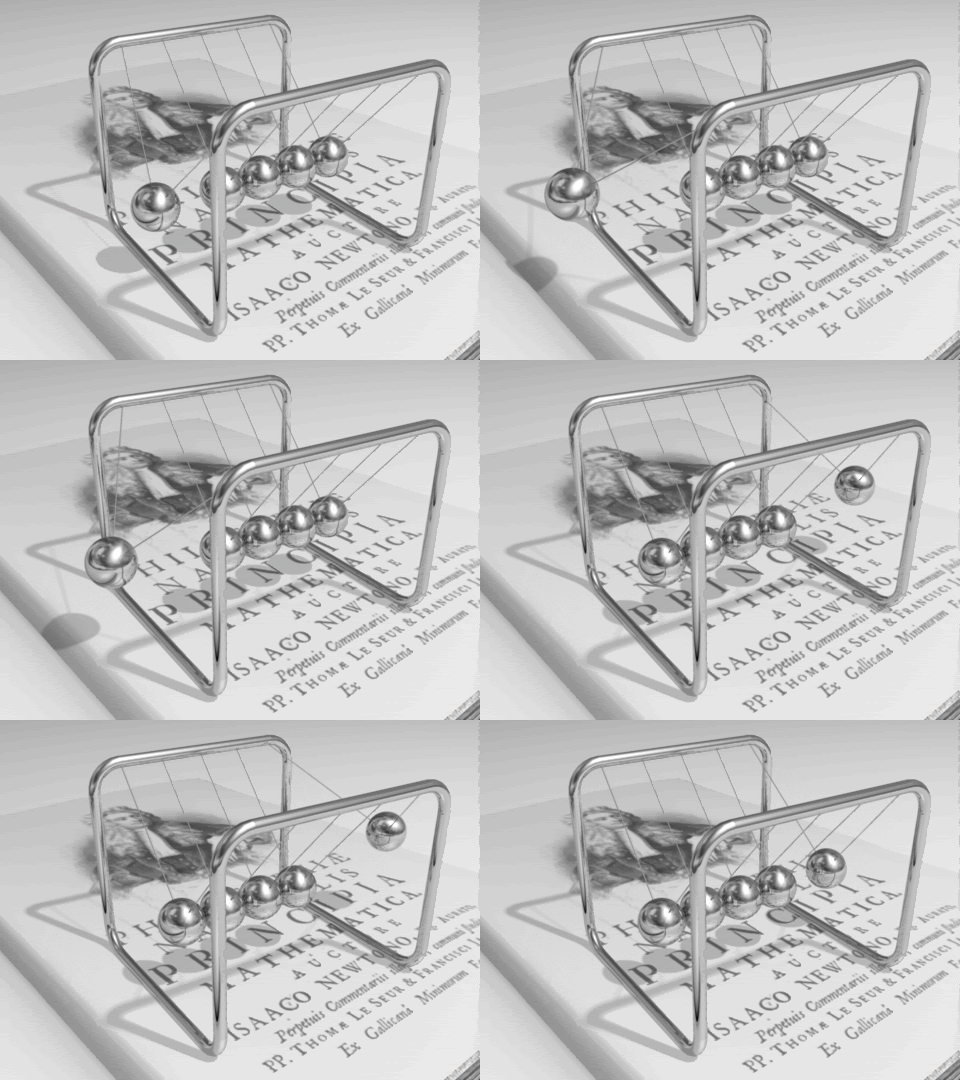
But like a Newton's cradle, when a ball strikes on one side, another ball rebounds in reaction. This wave of anti-religious media has caused a number of books to be written in response, such as God's Undertaker: Has Science Buried God? by John Lennox (spoiler alert: his answer is "no!"), What's So Great About Christianity? by Dinesh D'Souza, and The Devil's Delusion by David Berlinski. The potential positive result is that those people who take the time to carefully read and think through the points presented by both sides will realize that Christianity does have a reasonable response to all the attacks against it that have been raised by the New Atheists. But the ones who approach both sides with an even hand are rare; most people simply subscribe to the misportrayals of the other position given by their preferred side. And sometimes these misportrayals are so ubiquitous that even those who are being misportrayed believe that this is actually the way things are.

Consider these three common statements about the history of science and Christianity, gleaned and paraphrased from various articles and web postings:

  • Medieval Christians believed that the Earth was flat, until Columbus proved the Church wrong.
  • The Trial of Galileo was an example of how the Church placed dogmatic religious belief in geocentrism over the scientific evidence for heliocentrism.
  • The Scientific Revolution was a triumph of reason over religion, as the early scientists applied science to undermine the authority of the Church.
When I asked my high school students which of these statements were true, just about all of them stated that at least one was true, when in fact all three of these commonly held beliefs are false. My students, many of whom had attended Christian schools throughout their education, had somehow learned these myths in their classes or simply from the media portrayal of the history of Christianity and science.

The general belief is that Christians have always been opposed to science, holding on against the evidence to “anti-scientific” views such as:
  • A flat Earth
  • Geocentrism
  • The Universe was created by design
Belief in a flat Earth and geocentrism have been proven to be scientifically false, while the supernatural creation of the universe has not. But because of the perceived association between Christians and the first two erroneous positions, when Christians today try to present the scientific merits of a created universe, we are given the same credibility as if we were trying to make the case for a flat Earth or a solar system with the Earth at the center. Christians are caricaturized as being such close minded simpletons that we adhere to a wooden, literal reading of the Bible rather than accept what “Science” plainly reveals to all who think rationally.

Here's an example of this caricature (credit Steve Sack, Star Tribune, August 5, 2005):


This is the history that most people—Christians included—believe. But it is a false history, and it is one that Christians should strive to correct in the public perception. My goal with this series of posts is to provide the means to address the previous 3 myths about the history of science and Christianity, so that we can set them on a solid historical footing as we prepare them to be ambassadors for Christ. For when it comes to science and Christianity, history is in fact on our side.

Consider the conclusion of historian of science Colin Russell in his essay, The Conflict Metaphor and its Social Origins:
The common belief that… the actual relations between religion and science over the last few centuries have been marked by deep and enduring hostility… is not only historically inaccurate, but actually a caricature so grotesque that what needs to be explained is how it could possibly have achieved any degree of respectability” (quoted in John Lennox, God’s Undertaker, p. 26-27).
In my next post we will go back and consider the origins of this "conflict thesis" and address the Flat Earth Myth.

The ministry of teaching

Let me take the opportunity to share a bit on the inspiration for Reasonable Answers, as well as some background on my own journey into becoming a teacher. I will eventually transfer this into the "About Me" link in the sidebar, but I hope this helps put a personal side to this blog.

From all the way back in junior high school, I knew I wanted to do something involving science. I credit my 3 junior high teachers: Mrs. Miller, Mr. Sweeney, and Mr. Steele, for being so contagious in their enthusiasm for science. When I entered high school, my own faith journey started in earnest, and I received the calling to serve as a witness for Christ within academia. It was my conviction that I was to get a Ph.D in Physics, become a professor at a college, and make an impact for God in that role.

Things seemed to start on the right track as I was accepted to Harvey Mudd College as a physics major, and for two years I received a challenging education in the math, sciences, and humanities. But due to poor choices on my part, I took myself off the track that God had placed me on and made what I thought was a cope-out decision to transfer to Biola University (long story, which I may tell someday).

Someone once said (I believe it was C.S. Lewis but I can't find the quote) that when we sin, the good that would have been is lost forever, but then God does something even greater. And though I thought I had failed God's plan for my life, God showed me that He could bring about something greater.

At Biola, I began taking physics classes under Dr. John Bloom. Dr. Bloom initially arrived at Biola seeking a position in the theology department, but when the admins saw that he had a doctorate in Physics in addition to his doctorate in Ancient Near Eastern Studies, they asked if he would be willing to teach physics instead. He showed me how the study of physics didn't have to be simply a means to an end (ie. a professor position) but that the study of science itself could be a means of glorifying God. The lasting lesson I learned during my undergrad days at Biola was that God's glory and majesty was revealed in what He had created, and the more that I learned about the intricate workings of the universe, the more awestruck I was at how incredibly God had orchestrated everything together. During this time, God gave me my new purpose and calling, to share with others the glory of God through science through the ministry of teaching.

After graduating from Biola with a degree in Physical Science, I went on to receive a Masters in Theology from Talbot School of Theology, during which time I was serving as a youth counselor and pastor. Then, I heard about a new Masters in Science and Religion (MASR) program that Dr. Bloom had created and I was one of the first to sign up, as it was the perfect preparation for the purpose that I was seeking to fulfill.

After receiving the MASR degree in 2005, I accepted an opportunity to continue to fulfill my calling as an equipper of young people by becoming a science teacher at Maranatha High School, a private Christian school in Pasadena, CA, teaching AP and Honors Physics.

At Maranatha, I saw how many of our students were woefully unprepared to handle the potential attacks on their faith that they would face when they entered the naturalistic world view environment dominant in the colleges and universities they would be attending, mainly due to the lack of teachers knowledgeable in this area and a pertinent curriculum that they could learn from. There was a great need for a class to help prepare these students to understand and intelligently address the issues surrounding the interchange between science and faith, and to learn how to apply critical thinking skills and the wisdom of a wide range of thinkers and writers to develop a rational Christian thought framework capable of handling these critical issues. Last year, in response to my petitions to school administrators, I was given the privilege of creating a new elective Senior Theology course aimed at equipping those who will be pursuing degrees and careers in the sciences. Thus was born the class: Biblical Revelation, Scientific Revolution.

My experience in the MASR program was invaluable in the development of this course. In fact, it is fair to say that I would not have even considered creating this course had it not been for the conviction and knowledge that I acquired as a student in the MASR program. As a result, my students have deeply engaged and learned how to address issues such as the relationship between the revelation of Scripture and the natural world, the supposed “warfare” between science and faith, the characteristics of “fine-tuning” in the universe, the debate regarding evolution and Intelligent Design, and the moral and ethical issues surrounding current scientific technologies such as stem cell research and cloning.

Here is how one of my former students described his experience in the course:

One of Jesus' final commands to his disciples was "Go into all the world and preach the good news to all creation. Whoever believes and is baptized will be saved, but whoever does not believe will be condemned" (Mark 16:15-16). I believe that the new BRSR class at my school is a great help in fulfilling this command, as many atheists need to see scientific evidence for God before they will believe. As a likely future student at a secular school, one of my biggest fears about college was that science professors would harass me about my belief in Christianity and that I would be unable to stand up to them, giving those around me a negative view about Christianity. However, after having taken almost a full year of BRSR, these worries have been greatly alleviated because I now know how to argue against the naturalistic view that many scientists have today. The ability to defend my faith with reason will break the unfortunately common stereotype that Christians are ignorant and resistant to science. This will hopefully cause some other students in the class or maybe the professor to consider the possibility of Christianity being true. Therefore, the BRSR class will be a great help to me witnessing to people when I go off to a secular college. (Michael Bowerman, MHS class of 2009)
The class has been very well received in the two years since its inception, and the response from both students and parents has strongly affirmed my belief that this is a much needed class. In the first year, the two classes of this course that I taught were filled to capacity. More than 80 students (over half the senior class) registered for the class this year, even though I was limited to only taking a maximum of 50 students due to my obligations as a Physics teacher as well. The enthusiasm for the course is evidence I believe of how important an understanding of how faith and science interact is to these young people. If this hunger for understanding is not filled by a rational and faith-affirming framework, it can potentially be overpowered by the seemingly compelling arguments of the naturalistic scientific worldview. I have seen far too often how some of our best and brightest young people end up with their faith shattered after going through college, all because they did not realize that there were reasonable answers to the critical questions—especially those raised in their science classes—directed against their faith in God.

We need ambassadors who will directly impact the scientific establishment for Christ, and we need teachers who desire to reach the world by equipping the hearts and minds of our young people with the means to make a difference. It is my hope that more teachers and leaders will find opportunities to equip themselves in order to prepare students for an encounter with the mainstream scientific establishment. May Reasonable Answers (the blog) provide you with useful and relevant material to equip you for this purpose!

The need for Reasonable Answerers

Welcome to my first foray into the blogosphere! A little something by way of introduction to this blog...

In over ten years as a youth counselor and pastor, I have heard time and time again questions from young people on issues involving science and the Christian faith. The situation is no different in my role as a science teacher. With the authority given to scientists by our society, our young people are desperate for reasonable answers showing how science and theology can interact harmoniously. There is a distinct need for ambassadors for Christ who are capable of taking an intelligent stand for the faith, who are knowledgeable of the deeper issues and implications involved in the study of both nature and Scripture, and who have the character and wisdom to articulate this understanding in a convincing manner.

My hope is that this blog provides resources and insight to equip others to be such ambassadors, with reasonable and ready answers to the pressing questions of today, with specific focus on the interaction between science and theology.