Everyone knows the story of how Church officials strongly opposed Columbus’ voyage on the grounds that he would fall off the edge of the Earth. If you paid attention in history class, then you would remember that Columbus’ success in reaching America is thought to have proved the Church wrong about the Earth being flat by finally providing irrefutable evidence that the Earth is a sphere. Do you remember when you first learned this in school?
Some excerpts from grade school history textbooks which taught this:
Some excerpts from grade school history textbooks which taught this:

“[Columbus] felt he would eventually reach the Indies in the East. Many Europeans still believed that the world was flat. Columbus, they thought, would fall off the earth.” America Past and Present (Scott Foresman, 1983), 98.
“The European sailor of a thousand years ago also had many other strange beliefs. He turned to these beliefs because he had no other way to explain the dangers of the unknown sea. He believed . . . that a ship could sail out to sea just so far before it fell off the edge of the sea. . . . The people of Europe a thousand years ago knew little about the world.” We the People (Heath, 1982), 28-29.
And this excerpt, from a middle school earth science textbook:
“For thousands of years, most people thought that the earth was flat. But as early as 300 B.C., the ancient Greeks theorized that the earth was round. Yet they still drew maps of a flat earth.As people explored more of the world, they were able to map large areas of it. In 150 A.D., the famous Greek astronomer Ptolemy made maps that included Europe, Africa, and most of Asia. Even more important, these maps showed the earth as round!For hundreds of years after Ptolemy's work, mapping was neglected. Much knowledge of the world, as well as the idea of a round earth, was forgotten. In the fourteenth century, interest in Ptolemy's work was renewed. Once again, people believed that the earth might be round. Columbus's voyage to the New World was final proof that it was indeed round.” Prentice Hall Earth Science (1991), 213.
The problem with all of these accounts is that they are utter nonsense! States historian of science Jeffrey Burton Russell, “It must first be reiterated that with extraordinary few exceptions no educated person in the history of Western Civilization from the third century B.C. onward believed that the earth was flat” (“The Myth of the Flat Earth” by Jeffrey Burton Russell).
The Flat Earth Myth
The Flat Earth Myth is not the belief that the Earth is flat (see The Flat Earth Society for those who do hold this belief). Rather, the Flat Earth Myth is the notion that people in the past, particularly Medieval Christians, used to believe that the Earth was flat. This belief is still widely accepted as historical fact (how many of you thought it was true before you read this?), and it has been infused into the caricature of Christians that is circulated today.
Ironically, America Past and Present was my history textbook in 5th grade. And though this myth has been removed from most textbooks as a result of the work by historians of science, the fact is that many people continue to hold this belief, including many of the teachers currently teaching today.
You may have seen the image that appears at the top of this post. It is called the Flammarion Woodcut, and it is often shown as an illustration of Middle Age belief in a flat Earth, when in fact the origin of the woodcut appears to be from the 19th century, and was not intended to convey the idea of a flat Earth view.
So how did this myth become so prevalent today? Again, the popularization of this myth goes back to the 19th century, with historians like Andrew Dickson White (he who so loudly proclaimed the conflict thesis between Christianity and science) presenting the story of Columbus fighting with Church officials for support for his voyage:
“The warfare of Columbus the world knows well: how the Bishop of Ceuta worsted him in Portugal; how sundry wise men of Spain confronted him with the usual quotations from the Psalms, from St. Paul, and from St. Augustine; how, even after he was triumphant, and after his voyage had greatly strengthened the theory of the earth's sphericity, with which the theory of the antipodes was so closely connected, the Church by its highest authority solemnly stumbled and persisted in going astray.” (A History of the Warfare of Science with Theology in Christendom, Volume 1, Chapter II.3, Geography: Theological hindrance of Columbus)
The idea that White seems to be trying to convey is that even after Columbus provided “proof” of the Earth’s sphericity, the church continued to persist in its mistaken belief in a flat Earth. 
 However, modern historians of science have conclusively demonstrated that White and his contemporaries were wrong to associate the Middle Age Church with belief in the flat Earth. In actuality, the earliest mention that medieval people believed that the Earth was flat is found in the book, The Life and Voyages of Christopher Columbus, written by American writer Washington Irving, noted for other such historically accurate accounts as Rip Van Winkle and The Legend of Sleepy Hollow.
 However, modern historians of science have conclusively demonstrated that White and his contemporaries were wrong to associate the Middle Age Church with belief in the flat Earth. In actuality, the earliest mention that medieval people believed that the Earth was flat is found in the book, The Life and Voyages of Christopher Columbus, written by American writer Washington Irving, noted for other such historically accurate accounts as Rip Van Winkle and The Legend of Sleepy Hollow.
Consider Irving's description of the Council of Salamanca, during which Columbus tried to present the case for making his voyage before the learned men of his day, including various dignitaries of the church:
“To his simplest proposition, the spherical form of the earth, were opposed figurative texts of Scripture. They observed that in the Psalms the heavens are said to be extended like a hide, that is, according to commentators, thecurtain or covering of a tent, which among ancient pastoral nations, was formed of the hides of animals; and that St. Paul, in his Epistle to the Hebrews, compares the heavens to a tabernacle or tent, extended over the earth, which they thence inferred must be flat.” (The Life and Voyages of Christopher Columbus, 69).
Scans of the relevant pages can be found here.
Columbus’ Error
Columbus did indeed face resistance while searching for sponsors for his voyage, but the issue of contention was not whether the earth was flat or round, but over the size of the earth. Those who opposed Columbus believed that the circumference of the earth was too great for ships to sail around to the other side. There was no talk about “falling off the edge of the world.” Columbus had calculated that the distance for his trip from the Canary Islands to Japan would be about 4,450 km, which is one-fifth the actual distance of 22,000 km. If not for the placement of the Americas in between, Columbus and his crew would have surely perished, as his critics predicted. Columbus’ voyage—and later explorations by others—did not change the perception of the shape of the earth, but merely added new land masses to the Middle Age maps of the world.
Rather than being a bold triumph of science over superstition, Columbus’ voyage is proof that sometimes even dumb blind luck can make you famous.
Early Christian Thinkers who Wrote about the Spherical Earth
In fact, many early Christian thinkers wrote about the spherical Earth.
Thomas Aquinas (1225-1274) in his great systematic work Summa Theologica:
“Both an astronomer and a physical scientist may demonstrate the same conclusion, for instance that the earth is spherical; the first, however, works in a mathematical medium prescinding from material qualities, while for the second his medium is the observation of material bodies through the senses.” (Thomas Aquinas, Summa Theologica, vol. 1, trans. by Thomas Gilby (New York: McGraw-Hill Book Company, 1964), q.1, a.1.)The French Roman Catholic bishop Nicole Oresme (1323-1382) proposed several playful paradoxes dealing with a round and rotating earth, including one that established the principle behind changing time zones and the international date line for east-west travels. (Nicole Oresme, Lu Livre du Ciel et du Monde (1370), Bk. II, ch. 31, pp. 573-581.)
Oresme’s teacher, Jean Buridan, discussed the rotation of the earth.
All three of these Middle Age thinkers wrote as if the round earth was common knowledge, not something that still needed to be established.
Observations Affirming a Spherical Earth
These thinkers also presented observational evidences for the sphericity of the Earth: 1. The Shadow of the Earth during Lunar Eclipses
 Thomas Aquinas: “In [lunar] eclipses the outline [of the earth] is always curved: and, since it is the interposition of the earth that makes the eclipse, the form of this line will be caused by the form of the earth's surface, which is therefore spherical.” (Thomas Aquinas, Exposition of Aristotle's Treatise On the Heavens, 2 vols, trans. by Larcher, R. F., and Pierre H. Conway (Columbus, OH: College of St. Mary of the Springs, 1964), Book II, lect. 28. 400-402.)
2. Observation of the Stars in the Sky Johannes de Sacrobosco (1195-1256), an English monk, wrote an astronomical textbook that was used in universities for many centuries.
That the earth, too, is round is shown thus. The signs and stars do not rise and set the same for all men everywhere but rise and set sooner for those in the east than for those in the west; and of this there is no other cause than the bulge of the earth. Moreover, celestial phenomena evidence that they rise sooner for Orientals than for westerners. For one and the same eclipse of the moon which appears to us in the first hour of the night appears to Orientals about the third hour of the night, which proves that they had night and sunset before we did, of which setting the bulge of the earth is the cause. (Johannes de Sacrobosco, The Sphere, trans. by Lynn Thorndike, 1949, 10 Dec. 2004).3. Observations of a ship’s mast
 Sacrobosco also described how the dropping of a ship’s mast below the horizon as it sailed away was another proof of the spherical shape of the earth. This is an observation that all sailors would be familiar with, thus of all people sailors would be the least likely to be concerned about falling off the edge of a flat Earth if they sailed too far.
These examples show that a spherical earth was already an accepted fact in the early 13th century. So where then did Andrew Dickson White get this notion that sailors were terrified of sailing over the edge of the ocean?
Many a bold navigator, who was quite ready to brave pirates and tempests, trembled at the thought of tumbling with his ship into one of the openings into hell which a widespread belief placed in the Atlantic at some unknown distance from Europe. This terror among sailors was one of the main obstacles in the great voyage of Columbus. (A History of the Warfare of Science with Theology in Christendom, Volume 1, Chapter II.1, Geography: The Form of the Earth)Earlier Church Writings about a Spherical Earth
Even in the early Middle Ages, the Venerable Bede (673-735), a monk recognized as both a great historian and natural scientist, was already making clear statements about the earth as a sphere:
The cause of the inequality of the length of days is that the earth is round, and it is not in vain that in both the bible and pagan literature it is called the “orb of lands.” For truly it is an orb placed in the center of the universe; in its width it is like a circle, and not circular like a shield but rather like a ball, and it extends from its center with perfect roundness on all sides. (Bede, Bedae opera de temporibus, ed. C. W. Jones (Cambridge, Mass., 1943), chap. 32, quoted in Russell, 87)He specifically points out that the earth is not a flat disk like a shield but an actual ball or globe. Bede’s writings show that by this point, the Church saw no Scriptural conflict with a spherical earth.
The Controversy Over Antipodes
But discussions about the round Earth appeared even earlier in Church history. A controversy that arose within the church involving the shape of the earth was the issue of antipodes, the idea of people living on the other side of the earth with their feet facing in the opposite direction. The debate over antipodes has wrongly been viewed as an example of the Church rejecting a spherical earth, as the rejection of antipodes is often confounded with the rejection of a round Earth view.
But consider this explanation from St. Augustine, writing in the 4th century in his City of God:
But as to the fable that there are Antipodes, that is to say, men on the opposite side of the earth, where the sun rises when it sets to us, men who walk with their feet opposite ours, that is on no ground credible. And, indeed, it is not affirmed that this has been learned by historical knowledge, but by scientific conjecture, on the ground that the earth is suspended within the concavity of the sky, and that it has as much room on the one side of it as on the other: hence they say that the part which is beneath must also be inhabited. But they do not remark that, although it be supposed or scientifically demonstrated that the world is of a round and spherical form, yet it does not follow that the other side of the earth is bare of water; nor even, though it be bare, does it immediately follow that it is peopled. For Scripture, which proves the truth of its historical statements by the accomplishment of its prophecies, gives no false information; and it is too absurd to say, that some men might have taken ship and traversed the whole wide ocean, and crossed from this side of the world to the other, and that thus even the inhabitants of that distant region are descended from that one first man. (Saint Augustine, The City of God, trans. by Marcus Dods (New York: Modern Library, 1993), Book XVI, chap. 9)It can be clearly seen in this passage that Augustine does not refute the “scientific conjecture” that the earth is round, that “it has as much room on the one side of it as on the other.” What he rejects is the possibility that there could be inhabitants on this other side, men who were not descended from Adam. But from Augustine, we can see that even at such an early time in church history, a round earth was not considered to be an unacceptable view.
 Busting the Flat Earth Myth
This brief survey of key Christian thinkers during the Middle Ages shows that the Church was not opposed to the concept of a spherical earth, and that the conflict surrounding a round earth were not about the shape of the earth but over the belief in antipodes, men who were not descended from the line of Adam. This does not mean that every single person who lived during the Middle Ages knew that the Earth was round. Many of the common folk who were not educated about the issue probably lived their lives not knowing whether the Earth was round or flat, in the same way that many people today mistakenly believe that astronauts and objects in space float because there is no gravity in space.
The key point is that, with only a handful of exceptions, no educated person during the Middle Ages believed in the concept of the flat earth.
The two most oft cited exceptions are Lactantius (c. 245–325) and the early 6th century Greek geographer Cosmas Indicopleustes. An essay by Thomas E. Woods’—author of How the Catholic Church Built Western Civilization—gives a brief explanation for why these two were not influential.
Russell offers this explanation for why the Flat Earth Myth has been served up as truth since the 19th century:
The reason for promoting both the specific lie about the sphericity of the earth and the general lie that religion and science are in natural and eternal conflict in Western society, is to defend Darwinism. The answer is really only slightly more complicated than that bald statement. The flat-earth lie was ammunition against the creationists. The argument was simple and powerful, if not elegant: "Look how stupid these Christians are. They are always getting in the way of science and progress. These people who deny evolution today are exactly the same sort of people as those idiots who for at least a thousand years denied that the earth was round. How stupid can you get?"Any critic of the Christian faith who accuses Christians of being ignorant and opposed to scientific advances would do well to examine the actual writings of these early Christians before continuing to propagate “The Flat Earth Myth.”
But that is not the truth.
(“The Myth of the Flat Earth” by Jeffrey Burton Russell)
“Our determination to believe the Flat Error arises out of contempt for the past and our need to believe in the superiority of the present.” Russell, Inventing the Flat Earth
 For additional reading, consider the following:
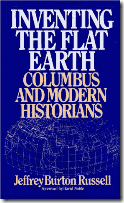
See the full text of Russell’s essay “The Flat Earth Myth” or his book, Inventing the Flat Earth: Columbus and Modern Historians
University of Oklahoma History of Science Exhibit on the Shape of the Earth
Article by historian of science James Hannam on The Myth of the Flat Earth
Gladio Mentis - The Sword of the Mind considers the Scriptural passages that are often mistakenly cited as "proof" that the Bible teaches a flat Earth in Round and Round We Go
Also, see this post from Hannam’s blog Quodlibeta on “The Deep Sleep of Adam” for some another example from the medical field of how Andrew Dickson White and others have misportrayed history when it comes to Christians and science.